Water management in municipal and user community settings is facing a paradigm shift. What was considered a purely operational and analog task just a few years ago now demands a strategic vision where technology is the only path to ensuring sustainability. To explore this reality, Hidroconta had the pleasure of speaking with Pablo Cárcaba, a member of the Lieres Water Community, who detailed a project that serves as an exceptional testament to how digitalization can rescue a network with historical deficiencies and transform it into a model of efficiency.
The Starting Point: An Invisible and Costly Reality
To understand the magnitude of the change in Lieres, one must analyze the scenario described by Pablo. The entity manages an extensive distribution network where, due to its age, the exact layout of the pipes in several sections was unknown. This lack of mapping data made it difficult to locate leaks that, by filtering directly into the ground, were not visible on the surface.
Until the improvement works began, consumption control was managed via individual meters that, in many cases, had reached the end of their lifespan or were malfunctioning, affecting measurement reliability. Furthermore, the community suspected unauthorized consumption—having already located three illegal connection points—which hindered the exact quantification of the resources used.
This technical situation placed the network’s efficiency below 30%. Additionally, traditional operations required a considerable logistical effort: manually reading more than 630 supply points required an investment of approximately 70 labor hours every quarter. In a climate change scenario, where periods of scarcity can reduce spring yields, optimizing every drop became more than just an improvement—it became a necessary responsibility to secure the future of the supply.
The Technical Solution: NB-IoT Connectivity with Centaurus S100
Faced with this diagnosis, the Lieres Water Community committed to a comprehensive transformation. As Pablo Cárcaba explained, it wasn’t about applying temporary patches, but rather addressing a technological unification that would unlock the full potential of data analytics.
The solution’s architecture is based on the installation of 637 Centaurus S100 smart meters. This device represents the vanguard of measurement, but its true competitive edge lies in its connectivity. The Centaurus S100 features Narrowband IoT (NB-IoT) technology embedded within the meter body itself, eliminating the need for external communication modules.:
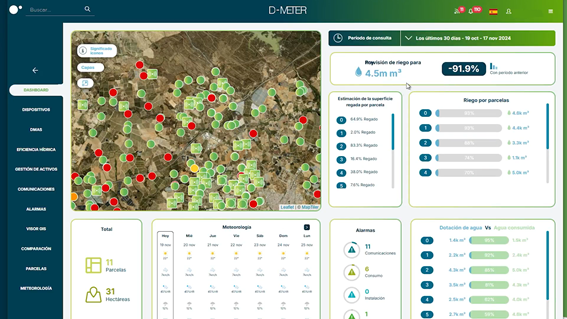
637 remote reading points and NB-IoT technology: The Lieres and Hidroconta project marks the path toward intelligent rural water management.
The choice of this technology meets criteria for robustness and sustainability:
 • Long-Range Transmission: Ensures stable data delivery even in areas with difficult coverage.
• Energy Efficiency: The equipment guarantees a battery life of up to 15 years, minimizing maintenance interventions.
• Sectoral Monitoring: In addition to residential meters, flow meters have been installed at various sections of the network. This allows for a comparison between the water injected into each sector with actual consumption, facilitating the early detection of zonal leaks.
Social Impact: Transparency and Trust
Beyond hydraulic performance improvements, Pablo highlights an intangible but fundamental benefit: the improvement in service perception. Following network incidents in 2023, there was some concern among neighbors regarding supply guarantees.
Years ago, the complexity of management had even led to proposals for municipalizing the service. Today, the situation is very different. The ability to generate alarms for reverse flow or proactively detect domestic pipe bursts has reinforced transparency and service quality. Residents have regained a sense of belonging and pride in a water community that is now perceived as a healthy and technologically advanced infrastructure.
“Digitalization doesn’t just save water; it rebuilds citizen trust and the pride of belonging to their community.”
The Future: AI and the Road to the Smart City
Lieres has not yet finished its digital journey. Pablo shared that the current project is the foundation upon which predictive management is being built. Currently, integrations with the Demeter API are being developed to connect remote readings directly with the billing ERP.
But the true frontier lies in Artificial Intelligence. The community is already working on integrating data into AI systems to study consumption trends and analyze network behavior patterns. This will allow them not only to detect a leak when it occurs but to anticipate anomalies, placing Lieres at the forefront of rural Smart Cities.